How to Play Sudoku
Sudoku is the world's most popular logic puzzle: a 9x9 grid you fill with the numbers 1 through 9. It looks like a math puzzle, but you never add or calculate anything — it's pure logic, and every puzzle can be solved by reasoning alone. Once you learn a few simple techniques, you'll be solving boards from start to finish.
The goal
Your goal is to fill every empty cell so that each of the nine rows, each of the nine columns, and each of the nine 3x3 boxes contains the numbers 1 through 9, with no number repeated within any row, column, or box. A puzzle is solved when the whole grid is filled in and that "1 through 9, no repeats" rule holds true everywhere at once. A well-made puzzle has exactly one correct solution that you can reach through logic, without ever guessing.
Setting up the board
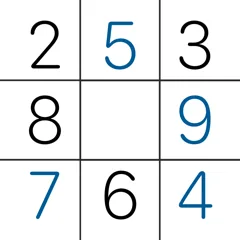
The board is a 9x9 grid of 81 cells, divided by heavier lines into nine 3x3 boxes. Some cells already contain numbers — these are called the "givens" or "clues," and they stay fixed for the whole game. The rest start empty, and those are the cells you fill in. Easier puzzles begin with more clues, while harder ones start with fewer.
How to play, step by step
- Learn the one ruleEvery row, every column, and every 3x3 box must contain each digit 1 through 9 exactly once. A number can never repeat inside the same row, column, or box.
- Scan for easy placementsPick a number, say 5, and look across the rows, columns, and boxes where a 5 already appears. In a box that still needs a 5, those existing 5s 'block' most cells — if only one empty cell is left where a 5 can legally go, place it there.
- Find naked singlesLook at a single empty cell and rule out every number already present in its row, column, and box. If only one number survives, that cell can only be that number, so write it in.
- Find hidden singlesWithin one row, column, or box, check where a specific number is allowed. If there is only one cell in that group where the number can possibly go, it must go there — even if that cell could also fit other numbers.
- Use pencil marks for the restWhen no more cells can be solved at a glance, write small notes (candidates) in each empty cell listing every number still allowed there. These notes let you see patterns and narrow choices without keeping it all in your head.
- Update notes and repeatEach time you place a number, erase that number from the notes in the same row, column, and box. This often reveals a new naked or hidden single. Keep cycling through scanning, singles, and note updates until the grid is full.
- Check your finished gridWhen every cell is filled, confirm that each row, column, and box holds 1 through 9 with no repeats. If something repeats, an earlier placement was wrong — back up and recheck your logic.
Beginner tips
- Start with the numbers and boxes that already appear most often — they give you the most clues to work from and the fastest early wins.
- Solve the easy placements completely before reaching for pencil marks; many beginner puzzles can be finished by scanning and singles alone.
- Keep your pencil marks accurate and up to date — outdated notes are the most common cause of wrong moves.
- Work in short focused passes: cycle through 1, then 2, then 3, and so on, rather than jumping around randomly.
- If you're stuck, switch your focus from 'what goes in this cell' to 'where can this number go in this box' — hidden singles hide in plain sight.
- Begin with Beginner or Easy difficulty and move up only once a level feels comfortable; each step up simply requires more of these same techniques.
Common mistakes to avoid
- Guessing when stuck. Sudoku is solvable by logic alone, and a wrong guess can send you down a path that breaks the whole grid later.
- Placing a number without checking all three groups. A digit must be legal in its row, its column, AND its box — beginners often check one or two and miss a conflict.
- Forgetting to update pencil marks after each placement, leaving stale candidates that lead to incorrect moves.
- Filling cells too eagerly. Writing a 'probably right' number as if it were certain causes errors that are hard to trace back.
- Ignoring whole rows or columns and focusing only on boxes — the same scanning logic works in all three directions and you'll miss placements otherwise.
- Jumping to a hard difficulty too soon, then feeling stuck because the basic techniques haven't become second nature yet.
Frequently Asked Questions
Is every Sudoku puzzle solvable without guessing?
Yes. A properly made Sudoku has exactly one solution that can always be reached through pure logic. If you ever feel forced to guess, it usually means there's a placement you haven't spotted yet.
How many numbers and cells are in Sudoku?
The grid has 81 cells arranged in a 9x9 square, and you use only the numbers 1 through 9. Each of those nine numbers appears nine times total across the finished board — once in every row, column, and 3x3 box.
Do I need to be good at math to play?
No. Despite the numbers, Sudoku involves no arithmetic — you never add, subtract, or calculate. The digits are just nine symbols, and the puzzle is entirely about logic and placement.
What's the hardest part of Sudoku for beginners?
The toughest moment is when no cell can be solved at a glance and you have to rely on pencil marks and techniques like hidden singles. Learning to spot where a number can ONLY go — rather than what a single cell can hold — is the key skill that gets you past this.
What do the small numbers (notes or pencil marks) mean?
They are candidates: the numbers still allowed in an empty cell based on its row, column, and box. They're a memory aid, not part of the solution — you replace them with a single final answer once you can prove which number belongs there.
What does difficulty actually change?
Harder puzzles start with fewer given clues and require more advanced techniques and longer chains of reasoning. The rules never change — only how much logic you need to apply to find each number.
Can a number repeat in a row, column, or box?
Never. The single rule of Sudoku is that each number 1 through 9 appears exactly once in every row, once in every column, and once in every 3x3 box. Any repeat means there's a mistake.
How long does a Sudoku puzzle take to solve?
It varies with difficulty and experience. Easy puzzles can take just a few minutes, while expert boards can take much longer. Speed comes naturally with practice as the techniques become automatic.
Ready to play?
Practice in Sudoku No Pop-up Ads — free, six difficulty levels, no pop-up ads.
Open Sudoku →